



G-Union
News
May 26, 2026
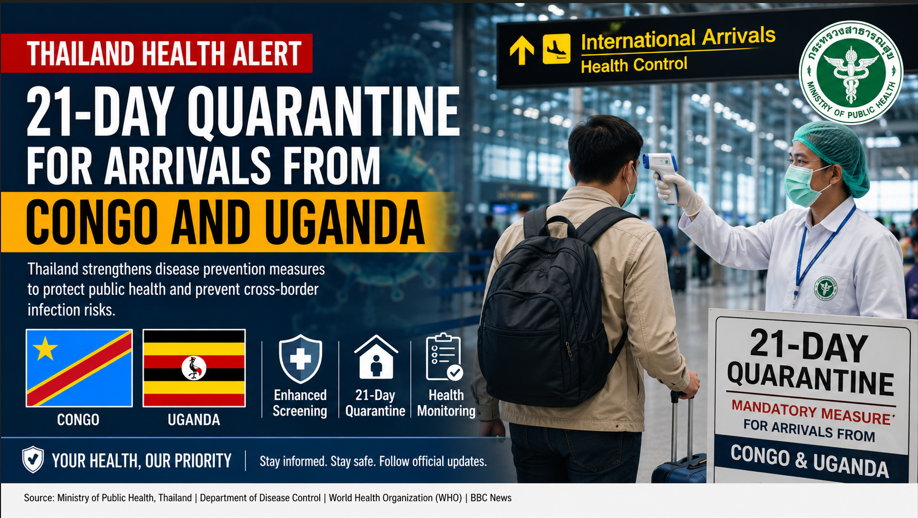
Thailand has officially intensified its disease-control measures by imposing strict 21-day quarantine and monitoring requirements for travelers arriving from the Democratic Republic of the Congo (DRC) and Uganda following the latest Ebola outbreak in Central Africa. The new public health measures took effect on May 21, 2026, after the Thai Ministry of Public Health designated both countries as dangerous communicable disease zones under emergency disease prevention protocols.
The decision comes after the World Health Organization (WHO) declared the Bundibugyo strain of Ebola in the DRC and Uganda a Public Health Emergency of International Concern (PHEIC) on May 17, 2026. According to WHO reports, the outbreak has already resulted in hundreds of suspected infections and dozens of deaths, raising international concerns about cross-border transmission risks.
Thailand’s Department of Disease Control (DDC) confirmed that travelers arriving from or transiting through the DRC will be required to undergo quarantine in designated facilities for at least 21 days, even if they show no symptoms. Meanwhile, travelers from Uganda without symptoms will remain under close health observation and must report regularly to communicable disease control officers during the 21-day monitoring period. Symptomatic individuals from either country will be isolated immediately in designated medical facilities.
Public health officials say the measures are necessary because the Bundibugyo strain currently has no licensed vaccine or approved treatment, increasing the urgency of early detection and strict containment. Airports and international checkpoints across Thailand have strengthened screening systems, including health declarations, thermal scanning, and travel-history verification. Authorities also confirmed that Thailand has not recorded any confirmed Ebola cases in 2026, but officials remain on high alert to prevent imported infections.
Experts note that Ebola has an incubation period ranging from 2 to 21 days, making long-term monitoring essential for disease prevention. The Ministry of Public Health has urged Thai citizens to avoid unnecessary travel to affected areas and advised returning travelers to seek immediate medical attention if symptoms such as fever, vomiting, bleeding, or severe weakness appear. International health agencies including the CDC and WHO have also issued updated travel and health advisories related to the outbreak.
As global concern over the Ebola outbreak continues to grow, Thailand’s rapid response demonstrates the country’s commitment to safeguarding public health and maintaining preparedness against international infectious disease threats. Authorities say the situation will continue to be monitored closely, and measures may be adjusted depending on developments in the affected regions.
Travelers are encouraged to follow official updates from the Thai Ministry of Public Health and international health agencies while prioritizing safety and responsible travel practices.